A medieval polymath amongst us
The archaeology of language
Imagine if da Vinci, Galileo, Copernicus, Newton, Descartes, Leibniz, Locke, Halley, were dropped into our midst and encountered the phrase…
Online Presence…
Most who read this piece are users of the technology that allows us to be heard; I suspect many can identify with the following collection of words and understand the meanings;
“I publish my own thoughts to a global audience using a self-hosted browser running on a virtual Ubuntu instance physically located on a server in Frankfurt.”
Our virtual visiting polymaths from the distant past might find that every single word in that sentence meant something completely different in their lifetimes;
- Server, a servant.
- Virtual, possessing virtue.
- Browser, a grazing animal.
- Instance, an urgent plea.
- Host a guest, or an army, or the Eucharist.
Just how many collocations, noun phrases, would we discover in human languages; to us quotidian; to them puzzling, bewildering beyond belief; and try explaining these ‘simple’ everyday terms;
- Record company, Oil company, Petrol station…
- Airport, Railway station…
- Trains, planes, cars, taxis…
- Self-hosted browser running on a virtual Ubuntu instance, physically located on a server in Frankfurt…
- Mouse pad…
- Desktop…
- Icon…
- IT…
Pick your polymath of choice; I name but a few of the giants upon whose shoulders we stand;
- Al-Khwarizmi, Ibn Sina (Avicenna), Omar Khayyam,
- Hypatia,
- Roger Bacon, Francis Bacon,
- Huygens, Pascal, Fermat,
- Hooke, Wren (architect AND astronomer),
- Benjamin Franklin, Thomas Jefferson,
- Goethe, Humboldt, Thomas Young,
- Ada Lovelace, Babbage,
- Helmholtz, Poincaré
Don the persona of your favourite, historically correct technology, general knowledge, politics, world views…become that person,
What would you make of our words and concepts today?
Remember, you have to pitch the answers to your 11-year-old self…
Infrastructure: motorway, flyover, roundabout, speed camera…
Vehicles: acceleration, horsepower, engine, dashboard…
Aircraft: plane, helicopter, 747, Concorde, jet, turboprop…
Spacecraft: ISS, Shuttle, rocket science, satellite, ICBMs…
Science: gravity, force, wireless, spectrum, speed of light…
Industries: Chip foundries, oil and gas, arms, paint…
Energy sources: wind turbines, geo-thermal, hydroelectric…
Disciplines: chemist, physicist, biologist, lawyer, dentist...
- Newton would grasp “gravity feed,” “force field,” “acceleration lane.” Would be baffled that “horsepower” measures engines, not horses. Would understand “spectrum” instantly; he invented the concept; would get “petrol station” eventually; station from the Latin statio, a standing place; petrol from petra, rock. A place where you stand to buy liquid rock. He’d want to know why rock is liquid and why you feed it to a carriage with no horses; wireless” without wires, but also a 1920s word for radio = “without wires” but not why you’d name a thing by what it isn’t. “Broadcast”; originally scattering seeds by hand. Now scattering information. The agricultural origin would be the only version any of them recognised.
- Aristotle; would probably pick a fight with the first dental technician over gender based toothiness; and biologists over bird migration maps and how 2,000 years of metamorphosis theory ran aground on 25 speared storks; Pfeilstorch- see appendix 1…
- Da Vinci would understand “helicopter” (helix + pteron, spiral wing; he drew one). Would grasp “anatomy” in a medical scanner. Would want to dismantle a drone. Would be bewildered that “studio” now means a small flat.
- Galileo would parse “satellite” instantly (a companion, an attendant — he named Jupiter’s moons). Would understand “telescope” but not “radio telescope”; a telescope that sees sound? Would grasp “orbit” but not “orbital road.”; an “airport”; a port for air? A harbour in the sky? He’d grasp it faster than the others, having already imagined things that fly.
- Pascal would understand “pressure” (he measured it). Would grasp “probability” in a casino. Would be amused that “pascal” is a unit of pressure AND a programming language, neither of which he intended.
Medicine: blood pressure, heart attack, immunity, clinical trials…
- Ibn Sina would grasp “clinical trial”; he wrote the rules. Would understand “quarantine” (quaranta giorni). Would parse “pharmacist” from pharmakon. Would be appalled that “drug” means both medicine and poison, and that society can’t decide which is which.
Maths: 0, rules for 1/0, coordinates, Riemann geometry…
- Descartes would understand “coordinate” (he invented them). Would spiral on “virtual reality” — the real that possesses virtue but doesn’t exist? His entire philosophy in two words. Would be devastated that “I think therefore I am” became a mug slogan {I think therefore I B M}; would spiral on “mouse pad” a cushion for a mouse? A mouse that isn’t a mouse? That moves a pointer that isn’t a pointer? On a desktop that isn’t a desk? He’d need a week and a dark room; as for “icon”; that WILL give him conniptions; “Icon” from Greek eikon, a religious image. Now a tiny picture you tap to open an app. The sacred image reduced to a shortcut… god in a box…
- Al-Khwarizmi would recognise his own name in “algorithm” but not recognise what algorithms now do. Would understand “zero” and “algebra”; he formalised both. Would be baffled that “cipher” means both nothing and a secret code.
Technology: smartphone, laptop, hard drive, software…
- Leibniz would recognise binary in every computer. Would grasp “calculus” being used for dental deposits and weep. Would understand “algorithm”; after Al-Khwarizmi, whom he knew of. Would be furious that “digital” comes from digits (fingers) applied to machines with none.
Domestic: microwave, dishwasher, white goods…
Commerce: credit card, contactless payment, shopping cart…
Social: rush hour, weekend, fiscal and monetary policies…
- Locke would grasp “social contract” (he wrote it). Would understand “consent” in cookie pop-ups and be horrified at what consent has become. Would parse “government shutdown” and say “yes, that’s the point.”
What do you think your favourite polymath/s from the distant past might make of the language of our modern lives…
“I publish my own thoughts to a global audience using a self-hosted browser running on a virtual Ubuntu instance physically located on a server in Frankfurt.”
- Server, a servant.
- Virtual, possessing virtue.
- Browser, a grazing animal.
- Instance, an urgent plea.
- Host a guest, or an army, or the Eucharist.
Remember, you have to pitch the answers to your 11-year-old self…
Comment; I’ll include in updates…
Appendix 1
A Pfeilstorch is a white stork that is injured by an arrow or spear while wintering in Africa and returns to Europe with the projectile stuck in its body.
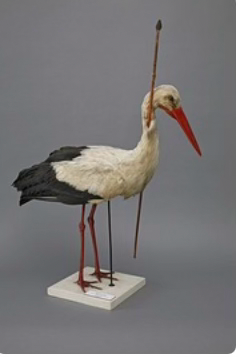
As of 2003, about 25 Pfeilstörche have been documented in Germany.
- 25 of them that still gets to me. Who the fuck is using storks as target practice?
- Haven’t they heard?
- That’s how babies get here..
- Perhaps that’s the reason…
- population control by spear, one delivery bird at a time...
The first and most famous Pfeilstorch was a white stork found in 1822 near the German village of Klütz, at the time in the Grand Duchy of Mecklenburg-Schwerin. It was carrying a 75-centimetre spear from central Africa in its neck…
The first and most compelling evidence for migration rather than Aristotelean metamorphosis…
Ok! I agree… on the evidence of most every bird evaporating over winter and reappearing, one assumes, the same that evaporated, in spring…
Is not easy or obvious, even to Deep Blue… but metamorphosis!!!
- That’s RIGHT up there with hearing hooves and thinking unicorns… at least try zebras first…perchance, even fing horses!
The specimen was subsequently stuffed (as Aristotle should have been) and can be seen today in the zoological collection of the University of Rostock.
Bruce's Philosophers Song
by Monty Python
Immanuel Kant was a real pissant
Who was very rarely stable
Heidegger, Heidegger was a boozy beggar
Who could think you under the table…
David Hume could out-consume
Wilhelm Friedrich Hegel
And Wittgenstein was a beery swine
Who was just as sloshed as Schlegel
There's nothing Nietzche couldn't teach ya
'Bout the raising of the wrist
Socrates, himself, was permanently pissed
John Stuart Mill, of his own free will
On half a pint of shandy was particularly ill
Plato, they say, could stick it away
Half a crate of whiskey every day
Aristotle, Aristotle was a bugger for the bottle
Hobbes was fond of his dram
And René Descartes was a drunken fart
"I drink, therefore I am"
Yes, Socrates, himself, is particularly missed
A lovely little thinker
But a bugger when he's pissed…
Writer/s: ERIC IDLE, GRAHAM CHAPMAN, JOHN CLEESE, MICHAEL EDWARD PALIN, TERRY GILLIAM, TERRY JONES
Publisher: Universal Music Publishing Group
Lyrics licensed and provided by LyricFind