Is Religion Ethical
Preface: the following is split into 5 sections, as follows;
- The Problem of Evil,
- Doctrine of Free Will,
- Doctrine of Double Effect,
- Machiavelli ‘The Prince’,
- The Trolley Problem.
Christianity, more than any other religion, has long struggled with just the bare bones foundation of belief, and faith; the duty of proselytising has always been a heavy burden of proof- ‘why Christianity is best’…
- the search for a self-evident, compelling logic has long been a tradition of metaphysical and philosophical thought within the Christian tradition…
This has been further compounded by the consideration of whether religious beliefs and commensurate acts are ethical;
- ethical in the sense of reciprocity;
- Before you kick the dog, become the dog…
- Does scripture judge you as
- Religious,
- But, humanity judge you…
- unethical…
- Does scripture judge you as
- Before you kick the dog, become the dog…
The first, the biggest Stumbling block…
- to a belief in an all-powerful, omnipresent, and all-good god is the problem of evil…
The problem of evil
The problem of evil is a philosophical and theological argument that tries to reconcile the existence of evil in the world with the existence of a supposedly all-powerful, all-knowing, and all-good God.
The problem of evil is typically presented as an argument in the form of a dilemma, which goes something like this:
1. If God exists, then he is all-powerful, all-knowing, and all-good.
2. If God is all-powerful, all-knowing, and all-good, then he would not allow evil to exist.
3. Evil exists.
4. Therefore, either God is not all-powerful, all-knowing, and all-good, or he does not exist.
And you can see why reason and syllogistic logic can be a cul-de-sac for those seeking an ethical foundation for religious beliefs…
Doctrine of Free Will
Augustine of Hippo (354 - 450), was born to a small landholder, Patricius, and a pious Christian, Monica, in the small town of Thagaste in the Roman province of Numidia (modern Souk-Ahras, Algeria).
Augustine of Hippo had a profound influence on the history of Western, Christian thought, and lived during a time of great turmoil under Roman rule.
The problem of evil
If God is omnipotent and good, why does evil exist?
Augustine’s answer: free will. He argued that
- everything that exists has good to some degree…
- evil is the absence of good…
- not a force of its own…
- evil is the absence of good…
- Privatio boni;
- privation of good, or
- scarcity of goodness…
- privation of good, or
Self-Defence
Augustine maintained that killing in self-defense was not permissible, arguing that…
- “private self-defense can only proceed from some degree of
- inordinate self-love.”
Justus Bellum - Just war
Augustine's “Just War Theory” became a foundation for later Christian thought on ethics and politics.
His writings tried to balance Christian pacifism with the realities of power and defence. He believed all war is tragic; a mark of human sin, yet
- accepted that force might sometimes be needed to protect the innocent and restore order…
- some wars can be just if they defend peace, have a just cause, such as defence, and a right intention to make peace, not take revenge…
- his ideas were later distorted during the Crusades, centuries after his death…
Doctrine of Double Effect
Tommaso d’Aquino, born some 1,000 years after Augustine of Hippo, more widely known as Thomas Aquinas was a very influential intellectual force in Christianity and western thought.
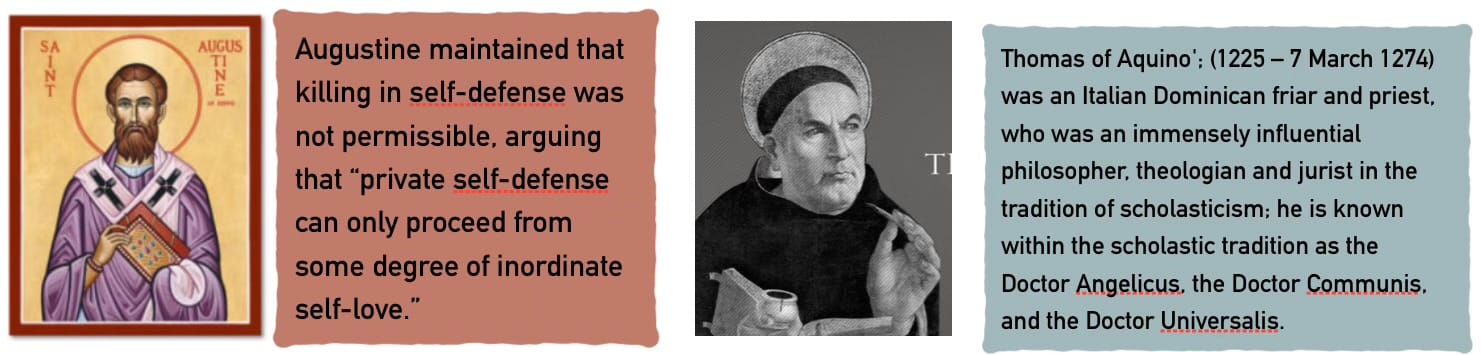
He took great exception to Augustine’s credo against self defence, feeling it was not only counter-intuitive, and just plain wrong not to be allowed to rise in one’s own defence, but it was also contradicted by Augustine’s, justus bellum, or a war in the name of the greater good;
In a personal conflict what greater good is there than the justus bellum of self-defence; did Augustine mean for holy warriors to simply concede their lives in the heat of battle because they faced a personal attempt on their own lives… clearly not, surely…not much point in going to war with that attitude…
Thomas, a man of great integrity, and a firm believer, racked his brains for a faith based equivalent to the reciprocal principle of ethics…
He recognised that a cause driven by scripture would fail the ethical test of reciprocity;
- Before you kick the dog, become the dog…
- Does scripture judge you…
- Religious, but..
- Humanity judge you…
- unethical…
- Does scripture judge you…
Well, by Thomas’s, and, by extension, Augustine’s justus bellum principle, the authority from scripture would depend on what kind of dog you were kicking;
- a black ‘heretical’ dog,
- a brown ‘devil’ dog…
- apparently god is a …racist…never…can’t be…
- a brown ‘devil’ dog…
However, after a mighty struggle, on a par with a later Cartesian struggle by a fellow believer tussling with the same imbalance between ethical and scriptural good…
- Thomas arrived at these four principles that, taken together, provided the closest ‘ethical’ basis for consistency with holy scripture…
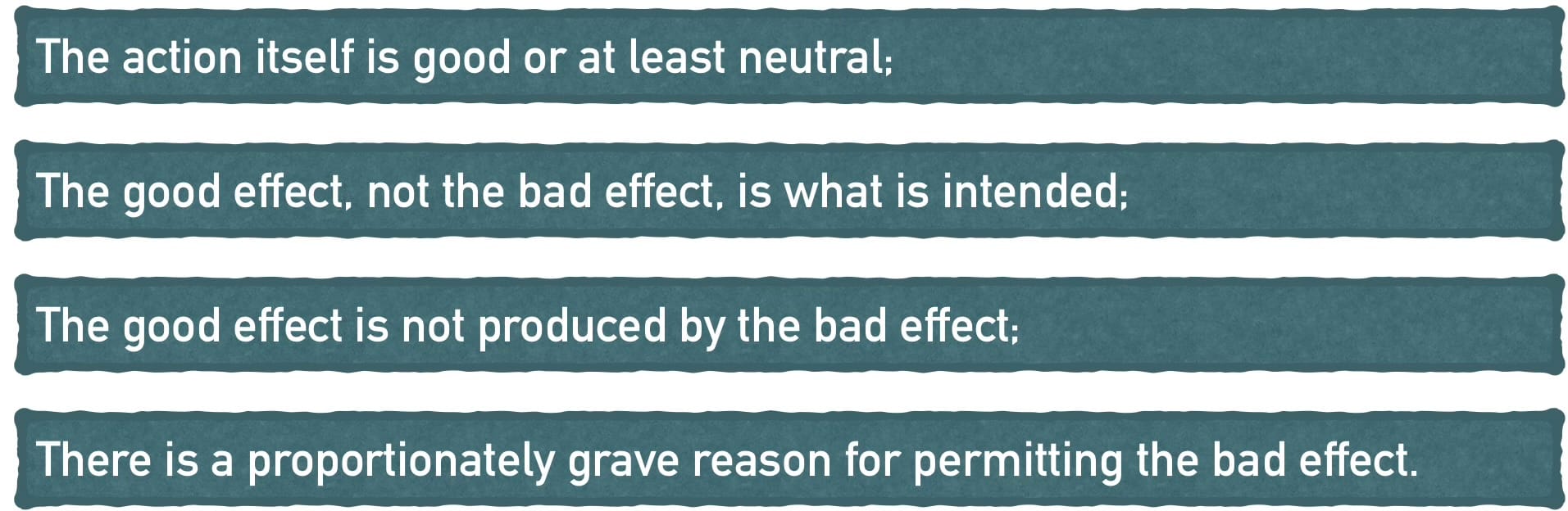
Wow! All the makings of a great board game on a par with Monopoly and Cluedo… and, gamed they were by the utilitarians… but I’m getting ahead of myself…
Non-Trivial Case study
‘One Night in November’ is a 2008 play by Alan Pollock, about the Coventry Blitz in November 1940 during the Second World War. The play was first performed in 2008 at the Belgrade Theatre in Coventry, England…
“On the night of 14 November 1940,
- 300 German bombers dropped
- 500 tons of explosives,
- 33,000 incendiary bombs and
- dozens of parachute mines on the industrial city of Coventry.
During the raid,
- 507 civilians were killed and
- 420 seriously injured…”
In the words of the press publicity: “… the play examines the idea that Winston Churchill had advance warning of the attack, many days in advance, but that he held back the information to protect the most important secret of the war: the breaking of the German Enigma code at Bletchley Park.”
Was Coventry sacrificed for the
- greater good?
- Or to provoke America into the war?
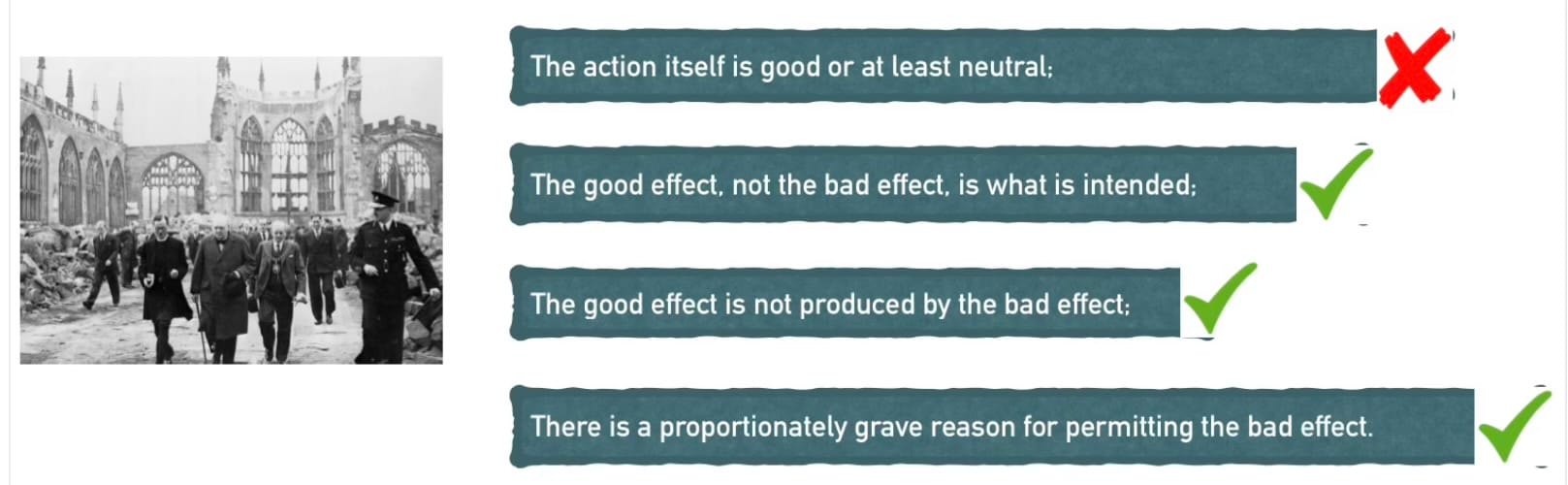
So, let’s apply the four rules of ‘DDE’, the latest board game, for teaching religiously correct, but ethically suspect decision making protocols…the closest Christianity could approximate to the…
- Before you kick the dog, become the dog…
the only universally acceptable principle that enables apex predators, such as ourselves, to live in relative harmony…
- No gods,
- No scriptures,
- No churches required…
- No scriptures,
Just be the dog, and you will know…
The DDE court judges work on the same ‘majority rule’ principle of SCOTUS…
As you can see from the checklist above;
- Point 1- good or neutral; uhm, No, not good karma…
- Point 2- safe bet then; though, not today, under Trump…
- Point 3- correlation not causation; Trump wouldn’t care…
- Point 4- safe bet then; under Trump, cause harm for pleasure…
In 1940, under Churchill, in a life-or-death war of ideology; the basis of the greatest good for the greatest number prevailed;
- allowing the Nazis to know their enigma was one no more, would have
“cost millions of lives and extended the war by 5 years”…
Machiavelli- ‘The Prince’
Nicolo Machiavelli; born May 3, 1469, Florence, Italy; died June 21, 1527, Florence.
On the surface, his philosophy is that of extreme pragmatism that anything and everything is justified if it serves the state. As Machiavelli presented it, everything a prince does should be for the benefit of their people, and that can include brutal punishments or deprivation of basic human rights.
Machiavelli was a republican. He served the Florentine Republic, was tortured when the Medici returned to power, and wrote the Discourses on Livy which is explicitly pro-republican. Then he writes
- ‘The Prince’; apparently a handbook for the very tyrants who destroyed his career and broke his body; and,
- dedicates it to Lorenzo de’ Medici…
Seriously unrecognised, satirical, piss-take of the Medici; or
- a volte-face to rival JD Vance…
My money is on it being Swift-like; a loaded baseline that never questions itself.
Just as Swift didn’t recommend eating Irish babies, so Machiavelli is not really condoning tyranny. He’s offering a reductio ad absurdum, a logic taken to absurdity to mock that which he is apparently putting on a pedestal… the sort of sycophancy Trump just loves… without any irony…
Like Swift, Machiavelli describes the logic so precisely that the horror became self-evident. Swift’s ‘Modest Proposal’ works because it never breaks character.
Just as Machiavelli in ‘The Prince’ never breaks character either; just presents the mechanics of tyranny with such clinical precision that the thoughtful reader achieves what Machiavelli intended, abhorrence of the world described, not of the messenger…
- The cruelty isn’t recommended.
- It’s anatomised.
The Prince doesn’t ask whether evil is justified. He asks whether it works.
- “It is better to be feared than loved, if you cannot be both.”
- DDE without the guilt…
- Augustine without the apology…
- Augustine without the apology…
- DDE without the guilt…
The Trolley Problem
Then came the utilitarians (Jeremy Bentham {1748 to 1832}, handing the baton to John Stuart Mill {1806 -73}) to turn the screw a bit looser and make a metaphysical conundrum into a parlour game; a thought experiment; a trolley problem…a maths problem…
- “it is the greatest happiness of the greatest number that is the measure of right and wrong” - Bentham (Mill agreed)…
- It’s ironic that proponents of such views see themselves as outside the ‘number’…
- drop these bastards in the ‘number’ missed and ask their opinion then…
- It’s ironic that proponents of such views see themselves as outside the ‘number’…
Ethics as a maths problem…
- This kind of thinking gave birth (Phillipa Foot in 1967) to ‘The trolley problem’:
“A runaway trolley (train) is heading down a track where 5 men are labouring…”
- Test 1- “you are standing by a set of switches…”
- Test 2- “you are standing on a bridge with a very fat man…”
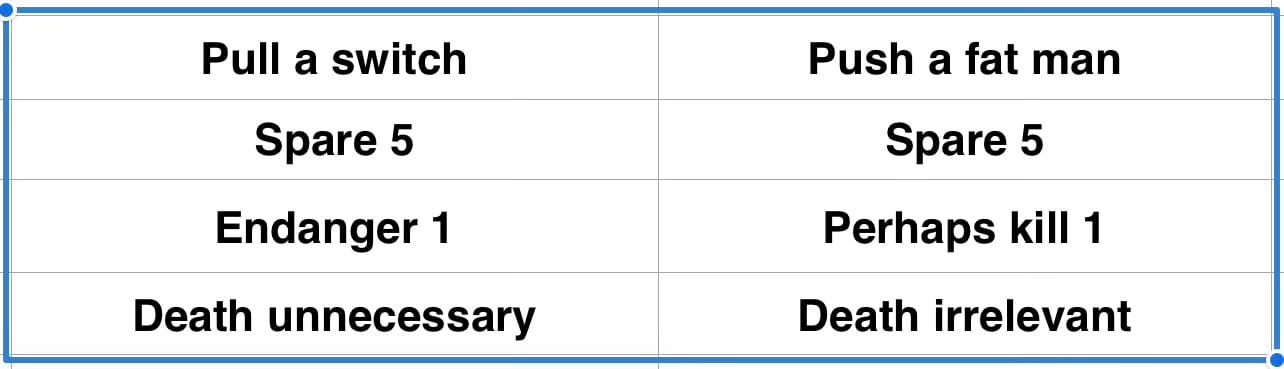
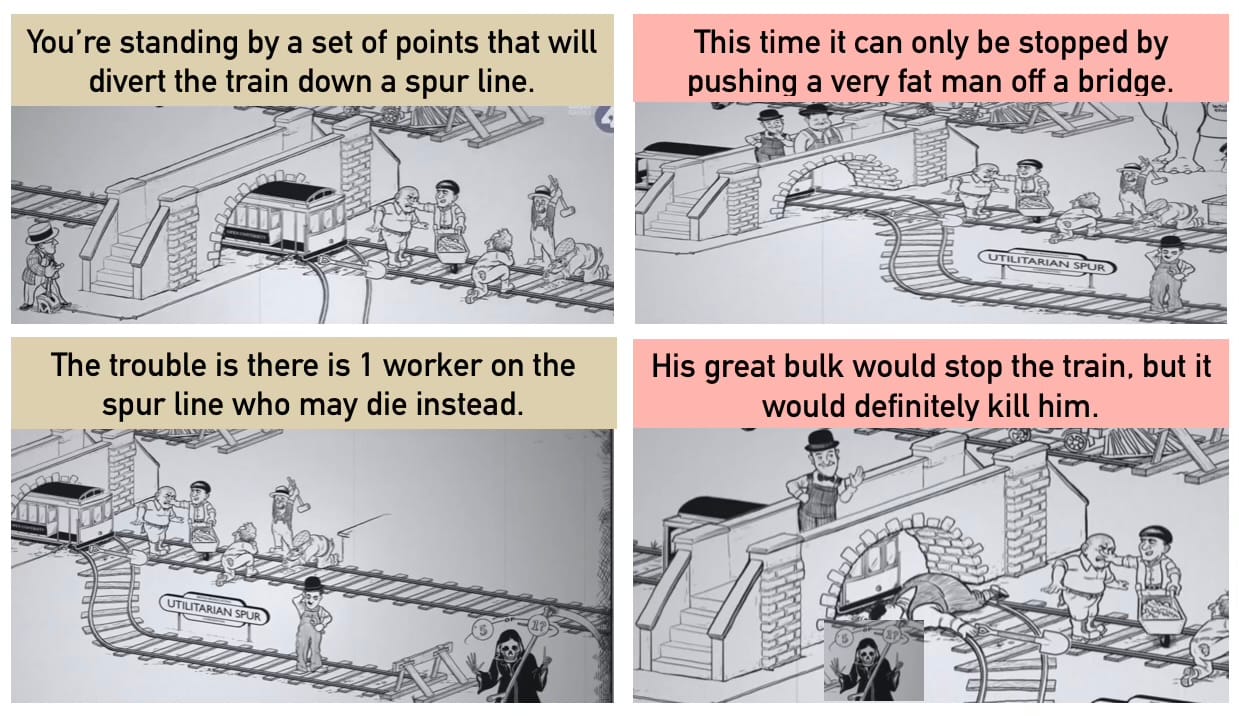
The greatest good for the greatest number.
The equation;
- 5:1 life exchange…
- Pull switch = push man ; pull/push logic…
- No material difference; both are…
- 5:1 life exchange…
- No material difference; both are…
- Pull switch = push man ; pull/push logic…
But only the first is ethical; that’s the difference that judges…
The east never needed DDE because it never separated good from evil into opposing forces.
- Karma,
- yin-yang,
- dependent origination…
- consequences are intertwined with actions,
- they’re not separable…
- like life and death are not separable…
- consequences are intertwined with actions,
- dependent origination…
There are as many paths to our enlightenment as there are pilgrims;
- one size does not fit all…
- one size only fits one…